Sabra and Shatila massacre: a scar that won’t heal

There are certain profound events in a nation’s history that leave an indelible mark on all its people. The massacre in two Palestinian refugee camps in Beirut, Sabra and Shatila, on September 16, 1982 stands as one of those events.

Taking place during the course of the Lebanese civil war, Israeli forces shot flares into the night sky, lighting the way for far-right Lebanese militias to carryout the systematic killing of up to 3500 Palestinian and Lebanese men, women and children. The massacre lasted 48 hours.

Sabra and Shatila signalled the end of an era for the Palestinian resistance movement. An era that grew from the refugee camps in Lebanon and honored Palestinian refugees and their right of return; an era that did not question the value of armed struggle in national liberation; an era that nurtured some of the best of Palestinian cultural and political life; an era that restored Palestinian dignity after the harrowing years that followed the Nakba.

In 1982, the U.S. administration betrayed the written guarantees they had given to the PLO to protect Palestinian civilians in the refugee camps. An article by Palestinian academic Rashid Khalidi in 2017 titled “The United States was responsible for the 1982 massacre of Palestinians in Beirut” studied what guarantees were given by U.S. officials and what they knew at the time. Khalidi also noted in his conclusion that the “ill-considered and morally flawed decisions about the 1982 war that were made by American policy-makers” continue to this day, with the same dangerous repercussions.

Nonetheless, a decade later, the Palestinian leadership agreed to the Oslo Accords, which we now know did immense damage to the Palestinian struggle. Where would the Palestinians stand now if the Oslo Accords had never been ratified, if the First Intifada had continued, if the PLO still inspired unity and stood for all the concepts encompassed in its name?

In 2007, on the 25th anniversary of the Sabra and Shatila massacres, I wrote a commentary that was presented on the Voice of Palestine radio show in Vancouver. Sadly, its words still ring true; we are still waiting for justice, not only for the victims and survivors of Sabra and Shatila but for all Palestinians.

“It was September 1982. The summer had been brutal, the Israeli invasion of Lebanon being the issue we lived with, woke up to, and went to bed with. There was no internet, and our days were consumed with obtaining even the smallest slivers of news about the Palestinian and Lebanese casualties of the war, that numbered in the tens of thousands. We organized rallies, raised money for humanitarian aid, but none of it could erase or even reduce the emotional turmoil we constantly faced.

And then, as we all debated how and why the PLO forces left Beirut with supposed U.S. guarantees for the safety of civilians, we began to receive the flickering images on our TV screens of piled up and disfigured bodies from Sabra and Shatila. At first, the full horror of it was not immediately realized, and again, it took some time before all the details emerged. At least 3000 civilians (bodies were dumped in mass graves so figures are at best conservative) butchered and mutilated by Lebanese fascist forces with the full support of the occupying Israeli army in manners almost too gruesome to think about. And all of this with American guarantees for civilian safety.

We were like people in shock, numbly going ahead with plans for large protests but knowing at some deeper level, that the tragedy here would take a long time to process.

Many events happened in the aftermath but none brought the smallest amount of justice to the Sabra and Shatila victims. Ariel Sharon was found complicit even by Israeli institutions, but then returned as prime minister some years later. The victims tried to receive some modicum of accountability with their lawsuit in Belgian courts, which was then squashed by pressure from U.S. and other governments. Once again, the massacre of Palestinians was an inconvenient reality, and the memory of it even more inconvenient.”

Perhaps the new normalization/weapons agreements that have just been signed at the White House, one day before the Sabra and Shatila anniversary, will be looked back on by future analysts as marking the end of another era. The era of U.S. hegemony, destruction, and disregard for the lives and livelihood of the Palestinian and Arab peoples. And only then will the scars of the Sabra and Shatila massacre truly begin to heal.

by Marion Kawas
Pubished Sept. 17, 2020 in Mondoweiss

CBC Insists on Erasing Palestinian National Identity

The following letter was sent on September 10, 2020 to the CBC Ombudsman requesting an official review of CBC’s flawed explanation of its language guide on Palestine. The Ombudsman has already confirmed that the review will happen, noting the results will be made public on his website.

Dear Mr. Jack Nagler,
CBC Ombudsman

We have received the more detailed reply regarding CBC’s language guide on Palestine from Paul Hambleton, Director of Journalism Standards. We understand many people received a very similar response with identical points defending CBC’s insistence on not using the word “Palestine” except in very rare circumstances (i.e. part of a name). Even in that, CBC management could not adhere to its own policy when Mr. Hambleton referred to the Palestinian Liberation Organization rather than the Palestine Liberation Organization in his reply.

We are not satisfied with this response and are requesting the Ombudsman Office to launch a review of this case.
Frankly, the more CBC explains this biased policy the more convoluted their verbal gymnastics seem to become. They have now shed more light on the relevant clause that started the whole fiasco and led to The Current apologizing on air for referring to Palestine, rather than the Palestinian territories. The full clause has fastidious detailing of when not to use the word Palestine; one cannot refer even to pro-Palestine supporters, they can only be pro-Palestinian. And when referring to historic Palestine, one must use the term “British Palestine” if talking about the period of British colonial rule after WW1.

Even if one puts aside CBC’s argument on Palestine not yet being a “sovereign country”, why this obsession with removing any usage of the word Palestine in nearly all other contexts, including generic or historic ones? The “British Palestine” reference seems particularly ridiculous and archaic in post-colonial times.

Here are some documented historic facts:
a. In 1896, the founder of Zionism, Theodor Herzl wrote in his book “The Jewish State”: “In Palestine (our emphasis) … we shall be for Europe a part of the wall against Asia, we shall serve as a vanguard of civilization against barbarism.”
b. In 1897, the First Zionist Congress listed as some of the aims of the movement: “Zionism strives to create for the Jewish people a homeland in Palestine (our emphasis) secured by public law. The congress contemplates the following means to the attainment of this end:
The promotion on suitable lines of the colonization of Palestine (our emphasis) by Jewish agricultural and industrial workers…”
c. The British Balfour Declaration that adopted and legitimized Zionism stated: “His Majesty’s government view with favour the establishment in Palestine (our emphasis) of a national home for the Jewish people…”
As demonstrated, Palestine existed and was referenced as such before and during the colonial British Mandate on Palestine, the official name of which explicitly recognized Palestine. For CBC to claim that it should now be referred to only as “British Palestine” is not just dishonest, misleading and a fabrication of history, it also adopts the narrative of the Zionist movement that denies the existence of Palestine and its people.

As CBC seems to fully understand that language is an important component of defining issues, we assume that they also understand that their policy makes them complicit in trying to eradicate Palestine’s national identity. This has long been a pillar of the Zionist project, which goes to great lengths to ensure that the Palestinian struggle is not framed as a national struggle against settler-colonialism.

Mr. Hambleton stated: “We think it would be misleading to state or imply that “Palestine” is a sovereign country (which is substantially different from having “non-member observer status” at the United Nations). We also think it would be inappropriate for the CBC to unilaterally declare that Palestine suddenly exists (where are its negotiated borders?)…”

We should inform CBC that Israel has never officially demarcated its “borders” (negotiated or non-negotiated), so by this logic, it is inappropriate for CBC to use the term Israel.

Although CBC does state the term “occupied territories” is preferred to “disputed territories”, most of their language guide nonetheless refuses to frame the Palestinian and Arab struggles as national ones against a foreign occupying power. The language guides also notes, after acknowledging that the Golan Heights is “occupied territory”, that this is territory “which Israel and Syria are at odds over”. “At odds over” – really? This is not the kind of precise language that Mr. Hambleton repeatedly insists CBC wants to use when reporting on these issues. The Golan Heights is not only occupied territory, it is also illegally annexed territory, and should not be represented as a “territorial squabble”.

In response to our question on how this language guide was developed, Mr. Hambleton stated that amongst other criteria, it was based “on research and interviews conducted by CBC foreign correspondents (including interviews with Israeli and Palestinian experts inside and outside the Middle East)”. He does not specify which “Palestinian experts” were interviewed or if they were even Palestinian. We would like him to clarify who these experts are because we seriously doubt any Palestinian or knowledgeable objective expert on Palestine and its history would have agreed to such restrictions on referencing the Palestinian national struggle.

It is interesting to compare CBC’s approach to language around Kosovo. Although each situation is unique, surely there are universal principles that should guide CBC’s policies. Kosovo is not a member of the United Nations in any capacity, it is recognized by fewer countries in the world than the state of Palestine, yet CBC is happy to use the proper term Kosovo in its reporting. The only difference we can see is that the Canadian government has officially recognized Kosovo, but not Palestine. Although CBC’s mandate states it has administrative and programming independence from the Canadian government, this doesn’t seem to be the case. Their website states: “This principle of ‘arm’s length’ relationship between the CBC and government is critical to the Corporation’s independence.” This “arm’s length relationship” doesn’t seem to have held up well. Shouldn’t we just acknowledge that our national broadcaster implements the foreign policy of successive Canadian governments in its reporting? A foreign policy that resulted in Canada twice losing out on a seat at the UN Security Council, a foreign policy that desperately is in need of a review, a foreign policy that has isolated Canada internationally. CBC could better serve people in Canada by discussing these issues rather than just simply reflecting the defunct foreign policy of the day.

Finally, we strongly believe that CBC is promoting the Zionist narrative, and the official Canadian position in support of that narrative; in doing so, this makes CBC complicit in the dispossession and genocide of a whole nation and its people. It is a sad and supreme irony that the program in which CBC enforced these biased policies and denied the existence of Palestine was titled “the themes of colonialism and resource extraction”.

Regards,
Hanna Kawas, Chair
Canada Palestine Association

Updated article in Canadian Dimension: CBC Doubles Down on Erasing Palestine

CBC Denies Palestine’s Existence

CBC has confirmed its official language guide dictates:

NO to Palestine as a country, NO to Palestine as an entity, NO to any map with Palestine, NO useage of the term pro-Palestine in generic ways

Are they Palestine-phobic? Or just racist? We have officially asked them to explain their process in arriving at such a sweeping censure of all things Palestine, and await their reply.

——————————————-

“I referred to the Palestinian territories as ‘Palestine,’ we apologize.”

This surreal statement was carried last week on CBC, Canada’s national broadcaster. Why? Because the guest host on The Current had dared to use the word Palestine during an interview. And to make the issue even more ludicrous, the interview was with graphic journalist and war correspondent Joe Sacco on “the themes of colonialism and resource extraction”.

The pro-Israel lobby group Honest Reporting (HR) quickly spun into action to tell CBC that in fact, the use of Palestine goes against CBC’s own language policies. Absurd enough yet??

Apparently, according to HR, this is from CBC’s language guide:

“… there is no modern country of Palestine, although there’s a movement to establish one as part of a two-state peace agreement with Israel. Areas under the control of the Palestinian Authority are considered Palestinian territories: Fatah-run West Bank and Hamas-run Gaza Strip.”

We will assume that this is accurate because the outrageous apology followed the day after the original interview. All of this led HR to gloat on their website about how they keep CBC in check regarding the non-existent Palestine.

And this isn’t the first time that activists have had to deal with CBC’s anti-Palestinian policies. Two years ago, Canada Palestine Association launched a formal complaint with CBC management that went all the way to their Ombudsman Office. It again involved changes in specific language that CBC had made in its reporting on Palestine after a complaint from HR, that time during the beginning of the Great March of Return. And it ended up (albeit through a much longer and winding route) with the same results – CBC stated it changed their reporting in order to more properly follow its own language guidelines. (Even though as regarded one point of terminology, the usage of “Arab Israelis” rather than Palestinians in Israel, the Ombudsman Office admitted there were no written protocols).

We hold CBC accountable for these decisions. The Zionist lobby is simply doing what it is meant to do – promote Israel by all means. Honest Reporting Canada clearly states on its website: “As an organization dedicated to defending Israel against prejudice in the media, we aim to provide educational tools and resources to anyone wishing to advocate for Israel”.

CBC on the other hand, is not doing what it is mandated and entrusted to do. Its “Journalistic Standards and Practices” document commits to accuracy, balance, objectivity and impartiality. And its governance policies are peppered with fine-sounding words like “reflecting differing views…fully and fairly…in a balanced manner…broad range of opinion”.

But just don’t say Palestine, or say that there are Palestinians in Israel. The mind boggles at how a reporter would have to handle a story talking about or with Palestinians under occupation, in exile and in the Galilee.

Never mind that 138 countries recognize Palestine as a state, as does the United Nations and multiple UN organizations. But no, CBC is following the same pattern as successive Canadian governments. Let’s not forget the same reasoning was used by the Trudeau government in claiming the International Criminal Court had no jurisdiction over the charges of Israeli war crimes in Gaza. Canada and its institutions are not representing the majority opinion of Canadians and are also completely out of step with international opinion. Its small wonder that they lost the recent bid for a UN Security Council seat.

Not CBC, nor the Canadian government, nor the Israeli government, can deny the existence of Palestine and its people. These churlish and supremacist attempts at erasing Palestinian identity will not succeed and only increase the resolve of the Palestinians and their supporters to fight for justice.

by Marion Kawas

Another version of this article was carried in Canadian Dimension.

Send a letter to CBC management here.

Why I support Dimitri Lascaris for Green Party leader

Canada has such a long history of complicity in Palestinian dispossession that there is an urgent need for people here to correct these historic wrongs. Our governments helped devise and implement the Partition Plan, our governments have kept silent on Israeli war crimes for decades, and most of the last two decades, Canadian governments have been proud to be one of “Israel’s staunchest/iron-clad friends”. While it is true that only the Palestinian people and their struggle on their land will be the path to liberation, nonetheless, we must also recognize the role of global solidarity.

We have seen the Palestinian issue censured, distorted, abused and misused by politicians from all the major Canadian political parties.  Despite the skepticism those events have engendered, I support Dimitri Lascaris for leader of the Green Party. Dimitri has stood up for Palestine multiple times in recent years, often at the expense of his own personal reputation and advancement. Whether it was York University students being falsely slandered, pro-Palestinian activists being smeared as anti-Semites, or grassroots campaigns to have Israeli settlement products correctly labelled: Dimitri has been there.

I applaud the foreign policy platform recently released by Lascaris, which also includes a call to end sanctions on Iran, Cuba and Venezuela as well as the universal application of international law. His comprehensive eco-socialist agenda on many issues, ranging from stewardship of the environment to confronting economic injustice, offers hope and sanity in these times of chaos and inequality.

I will be voting for Dimitri in the Green Party leadership contest and encourage others to do the same.  Please click on this link to join the party by September 3 and have your say.

Hanna Kawas,
Chairperson, Canada Palestine Association

Vancouver Actions to support the Palestinian People.

Saturday, Aug 8, 2 pm

Israeli annexation continues to threaten Palestinians in the West Bank, including the most fertile agricultural land of the Jordan Valley, which is still slated for Israel’s latest land grab.

Join us to stand against Israel’s annexation policy, the siege on Gaza, the mass imprisonment of Palestinians, the demolition of homes, the denial of Palestinian refugees’ right to return and further war crimes and crimes against humanity. Confront the continuation of over 72 years of land theft, dispossession, apartheid and genocide!

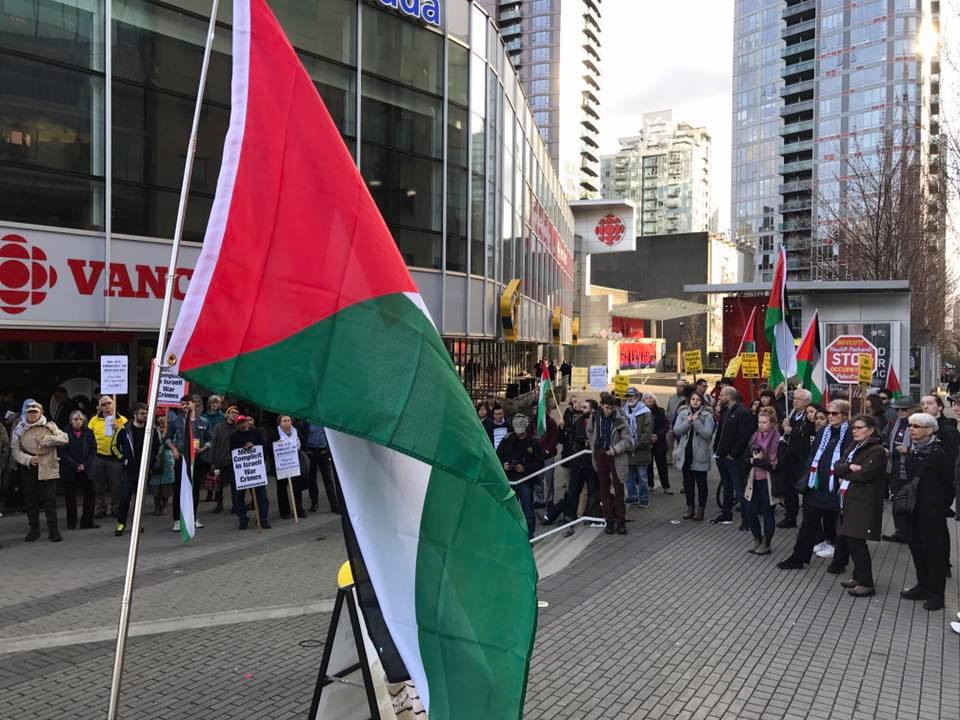
Join us SATURDAY, AUGUST 8 at 2:00 PM. We will gather at BROADWAY AND CAMBIE for a visibility picket before bringing our message to boycott apartheid to London Drugs and the BC Liquor Stores!

Facebook event page
Endorsed by:
BDS Vancouver – Coast Salish Territories, Canada Palestine Association, Samidoun Palestinian Prisoner Solidarity Network, Independent Jewish Voices – UBC, Solidarity for Palestinian Human Rights – UBC
** Note – COVID-19 protections will be followed! Please wear a mask and stay appropriately physically distanced – thanks! **

———————————————

Friday, July 31, 8 pm

Outdoor Left Film Night: Resisting Colonialism & Displacement From Secwepemc to Gaza

***Short Film Festival Featuring Empire Files on Palestinian Struggles & Tiny House Warriors Secwepemc TMX Resistance Mini-Doc***

Friday, July 31st 8pm @ Woodland Park (705 Woodland Dr.)
Facebook event page
Join the Young Communist League, Communist Party of Canada, Canada Palestine Association, and BDS Vancouver- Coast Salish Territories for the second outdoor left film night at woodland park. Bring your own folding chairs or blankets. We ask that folks be respectful of social distancing measures.