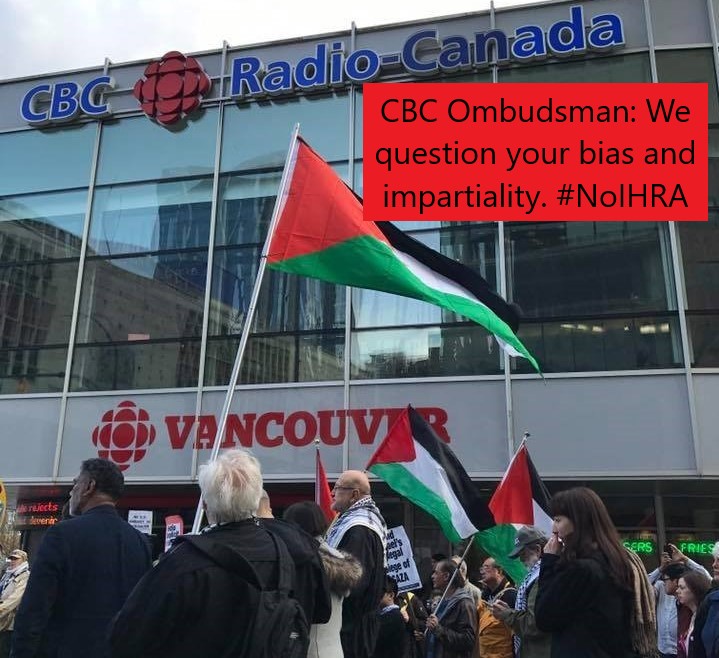
Is CBC Ombudsman impartial in his IHRA Vancouver review?

In his November 2022 Inbox, the CBC Ombudsman chose to comment on CBC’s coverage of Vancouver’s recent adoption of the IHRA; he did so before issuing his final report on an ongoing review, and clearly without any understanding of either the IHRA definition itself nor the dynamics of what happened at Vancouver City Council. Once again, it seems the CBC Ombudsman will fail the Palestinian community, similar to his 2021 ruling that the CBC “language guide” censoring the word Palestine was “reasonable”. The chairperson of CPA sent the following letter on December 6 to the Ombudsman, questioning his bias and lack of impartiality.

To Jack Nagler, CBC Ombudsman:

After reading your November 2022 Inbox, we feel compelled to express our opposition to the convoluted way you summarized the important issues brought up during the Vancouver IHRA debate.

You said:
“The journalistic issue seems to me less about whether there was controversy in either instance (there was), and more about the judgment CBC employs when deciding how much attention to pay to it. Unfortunately, there’s no single right answer to that question. The complaints have value, though, in informing programmers about Canadians who think CBC’s judgment calls are off-base.”

One of the pro-Israel groups supporting complaints to your office about CBC’s coverage on this issue, is now quoting this particular paragraph as proof that you agree with them.

You also noted: “It was the word “controversial” that seemed to spark most of the correspondence I received.” The reality in Vancouver is that the IHRA definition is, and was, and will continue to be, extremely controversial. And not just controversial; many people consider it to be a form of anti-Palestinian racism and suppression of free speech.

When the Union of BC Indian Chiefs, the BC Civil Liberties Association, and multiple other community groups that represent both Jewish and Palestinian advocates all stand with the same position, that the IHRA definition should NOT be adopted, then it would be amiss if Canadian media did not reflect this message. Even the Vancouver Sun covered the story in a similar vein, using the exact same terminology “controversial definition” in their headline.

To claim that giving coverage to this reality is potentially an “off-base” judgement call is not only misguided, it shows a complete disregard for what happened. You should consider that the complaints your office received were not a good indicator of how “Canadians…think” but simply part of a well-orchestrated campaign to shut down further dissent on this issue.

Your office should seek input on this issue from those who live in Vancouver, were actually part of this debate (where the vast majority of speakers opposed adoption of the IHRA), and who can attest to the fact that it was indeed more than “controversial”.

And finally, since you have chosen to speak on this issue even before issuing your final report, it is incumbent upon you to further educate yourself about what is included in the IHRA definition and its “illustrative examples”. It is not the initial short description included in your Inbox post that is the point of contention or even the intro to the examples; rather, it’s the 11 examples themselves, 7 of which reference the state of Israel and have been used to curtail criticism of the policies of Israel. This is the crux of the matter and has been well-documented, even by the main drafter of the definition. If you wish to rule fairly on this, you need to understand the background, especially in Vancouver where the IHRA was previously not adopted in 2019 by City council.

In fact, the main flaw in CBC’s coverage of this issue was its complete lack of any Palestinian point of view. As if Palestinians are not the direct victims of the IHRA’s suppression of their narrative, as if they are an “invisible” element to this debate, and as if there weren’t any Palestinian voices as part of the day-long City Council debate on the issue. The IHRA definition, while falsely claiming to fight one form of racism, is in fact promoting another: anti-Palestinian racism. It tells Palestinians their lived history cannot be openly expressed and that their narrative should be censored and limited; this is something many indigenous people have experienced at the hands of settler-colonialism.

We call on you, if there is any unbiased and impartial due process at CBC, to better inform yourself about the IHRA definition and the Vancouver City Council debate before you proceed further. You failed our community in 2021 when you ruled that CBC’s language guide was “reasonable” in its censorship of the word Palestine; we hope you won’t repeat this blunder again.

Hanna Kawas, Chair
Canada Palestine Association

Stop the smear campaigns against Palestinian Advocacy!

New Article in Mondoweiss: Fearmongering and intimidation by Canada’s pro-Israel lobby – Mondoweiss

(Over 85 Canadian and international organizations have endorsed this statement, as well as numerous individuals including Roger Waters. Join with them and send your own letter to Canadian officials here.)

Today, we are witnessing an intensified campaign by the pro-Israel lobby in Canada to smear Palestinian activists and their supporters. Last week, the National Post (NP) ran an online article about Palestinian-Canadian writer Khaled Barakat and the advocacy organization Samidoun. On April 30, the same article was splashed across their front page of their paper and has since been referenced in the Canadian Senate and the Jerusalem Post.

A year ago, Canada Palestine Association and 35 other concerned organizations issued a statement detailing their rejection of attempts to criminalize Samidoun, a Palestinian advocacy group for prisoners, by the Centre for Israel and Jewish Advocacy (CIJA). At that time, we said:  Should Canada’s policies on these important issues be decided by what the Israeli government dictates?

We repeat the question now. All of this recent hysteria can be traced back to the one article written by Terry Glavin. However, Mr. Glavin admitted in his own blog on April 29 that B’nai Brith first approached him with their “files” on the subject. He also thanked CIJA in the same blog entry for their assistance.

There seems to be nothing new in the recent defamation campaign, which relies heavily on already known social media posts and Israeli official and intelligence sources (which are mentioned at least 13 times in the NP article). So what pushed the Zionist lobby groups to resurrect this campaign at this specific time? Is it an attempt to deflect attention from the student union resolutions in support of Palestine at major Canadian universities? Or an effort to distract from the growing number of organizations that have expressly condemned Israeli practices as apartheid?

The French government recently tried to ban a Palestinian support group, “Collectif Palestine Vaincra”, but have already been forced by their own courts to suspend that decision.

We tell the Canadian government that the old smear tactics of “trial by fire” are not acceptable. As our statement last year concluded: “This criminalization of Palestinian advocacy is unacceptable and unfounded; Palestinian-Canadians and their supporters have no intention of allowing biased officials to suppress their democratic rights and their voices.”

Signed:
Canada Palestine Association-Vancouver
BDS Vancouver-Coast Salish

Endorsed by:
Academics for Palestine – Concordia
Actions4Palestine A4P, Toronto
Anti Imperialist Alliance, Ottawa
Association of Palestinian Arab Canadians (APAC), Ottawa, Ontario, Canada
Bayan Canada
BDS Caucus UTGSU
Barnard-Boecker Centre Foundation, Victoria BC
Canada Palestine Support Network (CanPalNet)
Canada-Philippines Solidarity for Human Rights
Canadian BDS Coalition
Canadian Foreign Policy Institute
Coalition Against Israeli Apartheid-Victoria
Communist Party Canada
East Indian Defense Committee (EIDC)
Edmonton Small Press Association
Friends of the Filipino People in Struggle – Coast Salish Territories
Free Palestine Halifax
Free Palestine YEG, Edmonton
Global Peace Alliance BC
GTA Palestine Movement
GT4BDS (Greater Toronto 4 BDS)
Hamilton Coalition to Stop The War
HR4A Saskatchewan, Saskatoon, SK
Independent Jewish Voices Canada
Independent Jewish Voices Vancouver
In Our Right Minds, Toronto
International League of Peoples’ Struggle Canada
Just Peace Advocates
Just Peace Committee-BC
Justice For All Canada, Toronto
Justice for Palestinians, Calgary
Labour for Palestine – Canada
Niagara Movement for Justice in Palestine-Israel (NMJPI)
Oakville Palestinian Rights Association (OPRA), Oakville, Ontario
OPIRG Carleton
Palestinian and Jewish Unity PAJU
Palestinian Student Society Association (PSSA), Guelph
Palestinian Youth Movement PYM
Palestine Solidarity Network – Edmonton
Peace Alliance Winnipeg
Secours Rouge Montréal, Montréal, QC
Simon Fraser University Students for Justice in Palestine, BC
Socialist Action
Socialist Project, Toronto
Students Against Israeli Apartheid U of T
Sulong UBC
Toronto Raging Grannies
Vancouver Peace Council
Venezuela Peace and Solidarity Committee, BC

Al Naqab Center for Youth (مركز النقب للأنشطة الشبابية), Burj el Barjneh camp, Lebanon
Alkarama (Palestinian Womens Movement), Spain
Arab Palestinian Cultural Club (APCC) Tripoli-Lebanon
Association for Investment in Popular Action Committees, California
Communist Youth of Sweden, SKU, Sweden
Free Palestine Movement, USA
Free Speech on Israel, UK
Friends of Sabeel North America
Indonesian Palestine Alliance IDPAL, Indonesia
International Solidarity Movement, Northern California
Jericho Boston , Boston
Jewish Network for Palestine (UK)
Jews for Palestinian Right of Return, USA
Labor for Palestine, US
Nakba Tour, California and Lebanon
Nevadans for Palestinian Human rights, Las Vegas
NYU Law Students for Justice in Palestine, NYC
One State Assembly, Palestine
PAAF PEOPLE AGAINST APARTHEID AND FASCISM, Cape Town
Palbox, Oregon
Palestine Children’s Welfare Fund, California
Palestine Solidarity Alliance, South Africa
Palestine Solidarity Campaign – Cape Town|
Palestinian Cultural Club – Beirut (PCC), Lebanon-Beirut
Palestinian Union in Latin America|
Party for Socialism and Liberation, United States
Peace, Justice, Sustainability NOW, Florida
Popular Conference for Palestinians Abroad, Lebanon
(لبنان – المؤتمر الشعبي لفلسطينني الخارج)
Resumen Latinoamericano, California
Revolutionaire Eenheid, The Netherlands
Serena Shim Award, California
Shurok, Spain
Students for justice in Palestine – Rutgers, New Brunswick, NJ
Students for Justice in Palestine at Butler University
Students for Justice in Palestine at UC Davis, California
Students for Justice in Palestine, Chicago
Students for Justice in Palestine, Wayne NJ
Students United for Palestinian Equal Rights – University of Washington
Syria Support Movement, International
Veterans for Peace, CA, USA

Individual Endorsers:

  1. Ali Mallah, Justice Activist, Toronto
  2. Allan Hansen, Industrial Pipefitter, Edmonton, Alberta
  3. Andrew Brook, Retired academic, Ottawa
  4. Angie Mindel, Retired, Nottingham U.K.
  5. Anna Willats, College Faculty and Coordinator, Toronto, Ontario, Canada
  6. Barry Heselwood, Academic, Keighley, UK
  7. Beyaz Almas, Worker, BC
  8. Bill Skidmore, Retired professor, Ottawa, ON
  9. Cathy Cronin, Regular Canadian, Napanee  Ontario
  10. Cathy Gulkin, Documentary filmmaker, Toronto, Canada
  11. Christine McMillan, Retired teacher and tax officer, England UK
  12. Ciara Taylor, NYU law student, New York
  13. Claude Brasseur, Activist, St-Albert, ON
  14. Daphne Stapleton, Peace Activist, Toronto, Canada
  15. Dave Diewert, Retired teacher, Surrey, BC
  16. David Fairn, Journalist, N.S.
  17. David Low, Clergy, St. Catharines, Ontario
  18. Davidi Hadley Finke, Quaker leader, Peace Advocate, Oberlin, Ohio — Land of the Erie
  19. Dorothy Field, artist/writer, Victoria BC
  20. Dr. David Maxwell, Physician, Nova Scotia
  21. Dr. Dwyer Sullivan, Retired high school teacher of Social Justice and World Religions. Kitchener, Ontario
  22. Dr. Jodi Braine, Concerned global citizen, Fredericton, NB
  23. Egbert Harmsen, Activist for human rights, Leiden, The Netherlands
  24. Elie Halabi, Administrator, Repentigny
  25. Ellen Franzen, retired, Berkeley, CA
  26. Emad Hammoud, Self-Employed , London
  27. Enver Domingo, Retired, Oakville Canada
  28. Fahad Chowdhury, Professional Engineer, Elkford
  29. Faris Ziyad, Academic, Chicago
  30. Frances Combs, clergy, Toronto
  31. Frank Holden, Actor/folksinger/writer/human rights activist, St. John’s
  32. Genie Silver, Academic, Pennsylvania, US
  33. Giorgio Ramadhan, Lawyer, Indonesia
  34. Gord Doctorow, Ed.D, Retired educator. Toronto, Canada
  35. Greg Albo, academic and author, Toronto
  36. Haim Bresheeth-Zabner, Academic, author and filmmaker London, UK
  37. Henry Zaccak, CEO, Toronto
  38. Himani Bannerji, Professor, Toronto
  39. Issam Alyamani, Writer, Mississauga, Canada
  40. Jake Javanshir, Activist, Toronto
  41. Jalal Kawash, Academic, Calgary
  42. James Dickins, Academic, Leeds, United Kingdom
  43. Jan Corderman, Peace Activist, Pleasant Hill, Iowa
  44. Jan Steven, mother, grandmother, wife St. Catharines
  45. Jane Collier, Academic, United Kingdom
  46. Jane Story, former journalist, Toronto
  47. Jeff Winkelaar, Retired, Edmonton
  48. Jennifer Whitfield, Activist, Newfoundland, Canada
  49. Jim Mitchell, m.d., Toronto
  50. John Darling, Retired NDP activist, Toronto, Ontario, Canada
  51. John Grant, Retired, UK
  52. John Liss, lawyer, Toronto
  53. John Mark Robertson, Social Service Worker, Belleville, Ontario
  54. Jonathan Kuttab, Executive Director, Friends of Sabeel North America (FOSNA)
  55. Judith Goldschmidt, Jewish Human Rights Activist, Courtenay, BC
  56. Karen Platt, Jew with a conscience, Albany CA
  57. Karen Rodman, Ordained clergy, human rights advocate, Kawartha Lakes
  58. Kate Chung, Grandmother, Toronto
  59. Katerina Nikas, Writer, Halifax, Nova Scotia
  60. Kathleen Von Riesen, Reg, Nurse, Newfoundland & Labrador
  61. Kevin Gould, Associate Professor, Concordia University, Montreal, Canada
  62. Khaled Husseini, Business Owner, Ottawa
  63. Khaled Mouammar, Former Member, Immigration and Refugee Board of Canada, Richmond HIll, Ontario
  64. Khan Jooneed, Journalist, Writer, Human Rights Activist, Montreal, CANADA
  65. Laila Atallah, Lawyer,United States
  66. Laura June Rose, Food industry worker, Vancouver
  67. Lawrence Sutherland, Activist, Winnipeg, Manitoba
  68. Lesley McGorrigan, University worker, UK
  69. Lorraine Michael, Retired Politician, Newfoundland and Labrador
  70. Louise Seidel, Artistic Producer of Theatre, Saskatchewan,
  71. Lynette Bondarchuk, Artist; NPO Administrator; Tenants Advocate, Edmonton
  72. Manhal Alfalasteny, Artist, singer, Tunisia
  73. María Alejandra Torres, Law student, NYC
  74. Mariam Furre, Geographer, Ottawa
  75. Mark Hagar, Retiree, Hamilton
  76. Mark James, Academic, Ontario
  77. Marlena Santoyo, Jewish activist, Philadelphia, USA
  78. Martin Fontaine, agent de pastorale, Montréal
  79. Michael Hajjar, Student, Chicago
  80. Michael Kuttner, Teacher (retired), Toronto
  81. Michal Sapir, Writer and musician, Tel Aviv
  82. Mike Cushman from Free Speech on Israel (UK)
  83. Monica Harhay, Concerned citizen, Toronto, Ontario
  84. Nancy Withington, academic; wife of Palestinian refugee, Santa Barbara, Ca.
  85. Nora Lester Murad, writer, educator, social justice activist, Massachusetts, USA
  86. Norma Rantisi, Academic, Montreal
  87. Pete Firmin, Activist, London
  88. Peter Eglin, Professor Emeritus of Sociology, Kitchener
  89. Peter Purich, Technical Writer (retired), Ottawa
  90. Phyllis Creighton, author; retired editor, scholarly publication, Toronto
  91. Rachel Marandett, NYU Law Student, NYC
  92. Rashmi Luther, Academic (Retired), School of Social Work, Carleton University
  93. Rebecca Hagey, Retired professor, Lion’s Head Ontario
  94. Rehab Nazzal, Visual artist, Toronto
  95. Rev. F. Mark Mealing, Ph.D., Anglican Priest & retired Academic, Meadow Creek, B.C.
  96. Rev. Lilian Patey, Clergy, Windsor, Ontario
  97. Richard Kuper, Researcher and campaigner, London, GB
  98. Richard Thoreau, Retired, Victoria
  99. Robert Assaly, Priest, Montreal
  100. Robert Fantina, Author and activist, Kitchener, Ontario
  101. Robert Kent, Emeritus Professor, Computer Science, Elkford, B.C.
  102. Roger Waters, Musician /Activist, NY
  103. Roland Verrier, Retired, Coquitlam, BC
  104. Roswitha Shaw, retired, Ottawa
  105. Salim Assi, Artist, Art of resistance, Copenhagen Denmark
  106. Samuel Miriello, Human Resources Professional, Montreal
  107. Sara Traub, educator, Thornbury
  108. Sean Phipps, Teacher, Vancouver
  109. Sheila Dunnachie, Retired union activist, Mayne Island
  110. Sherry Ann Chapman, Engaged citizen, Edmonton
  111. Sid Shniad, Founding member, Independent Jewish Voices Canada, Surrey, B.C.
  112. Simaan Khoury, President, Palestinian Union of Latin America, El Salvador
  113. Sue Lyon, Advocate, Kingston
  114. Susan Stout, union activist, North Vancouver
  115. Teresa Diewert, Teacher, Surrey, British Columbia
  116. Terri Ginsberg, film scholar, Montreal, Quebec
  117. Terry Gallogly, Retired, York
  118. Thomas Brown, Academic (mathematician), Vancouver BC
  119. Tony Greenstein, Writer and blogger, Brighton UK
  120. Vera Szoke, Retired Highschool Teacher, Toronto, Canada
  121. W. T. Beckett, Human Rights Activist, St. John’s, NL
  122. Walid Alawar, Businessman and social activist, Ontario
  123. Walid Eletry, supporter, Ajax,Ontario
  124. William Ruhm, Social worker, Boston, MA
  125. Wolfe Erlichman, Member, Independent Jewish Voices, Godfrey, ON
Canadian company financing Israel-UAE collaboration

In June of this year, the story of how Dubai Ports World was helping to squash opposition to the Israeli Zim shipping company in a small Canadian town caught the interest of many progressives worldwide. Lest anyone think this was an isolated incident, Canadian media recently highlighted another saga of Canada-UAE-Israel partnership.

This time around, former Canadian prime minister Stephen Harper is taking centre stage as the head of the advisory committee to Toronto-based AWZ Ventures. According to a CBC article, “AWZ Ventures finances Israeli surveillance technology systems, including facial recognition and crowd detection systems and services that deliver comprehensive information on individuals in real time.”

The media focus now is that AWZ Ventures is facilitating the sale of this “technology to the United Arab Emirates — a country with a troubling human rights record”. (No mention of Israel’s “troubling human rights record”, mind you.)

Again, as with the Zim story, the finer details are bizarre. Not only does AWZ Ventures have former Mossad, CIA and MI5 figures on its advisory board, it is also opening a subsidiary in the UAE. And heading up this new subsidiary with be the former Canadian diplomat and representative to the Palestinian Authority, Katherine Verrier-Fréchette.

The new company, aptly dubbed AWZ Horizons, will also be helping to promote the sale of this Israeli technology “to other countries in the Middle East, such as Saudi Arabia, and countries in North Africa.” This seamless transition from Canadian diplomatic envoy to high-level cybersecurity merchant speaks volumes about the “neutrality” of Canadian foreign policy.

AWZ Ventures itself is an interesting study. Along with the notable international figures, Richard Fadden, former director of the Canadian Security Intelligence Service works for the company. And former Conservative cabinet minister Stockwell Day is also reportedly involved.

Fadden, one of the few who was quoted by Canadian media, said: “A lot of this technology is useful in fighting terrorism and that was my main interest,” he said. “Some of the technology that has been developed helps develop a sense of what’s going on, on the one level on social media, so you can accumulate information…”

In July of this year, AWZ Ventures also entered into an official partnership with the Israeli Ministry of Defense and its Directorate of Defense Research and Development (MAFAT) and launched Awz X-Seed. The goal of this new spin-off will be to invest in “pre-seed” and “inception” stage companies in Israel developing innovative security technologies. According to Stephen Harper at the time: “Together, Awz and MAFAT will uniquely evaluate and develop early-stage technologies, creating a model that is unmatched anywhere.”

It was also noted that the “Portfolio companies will further benefit from Awz Ventures’ business development offices in Canada, the US, and UAE that will support the companies in expanding their global client base.”

So, to sum up, a Canadian-based company with an advisory board headed by a former Canadian PM and full of former spies, is marketing Israeli cybersecurity and surveillance technology to dictatorial Arab regimes. And even partnering with the Israeli government to help develop more of the same.

The detrimental use of these technologies has been well-documented in recent years, the most notable case being a possible link in the murder of Jamal Khashoggi. Journalists and human rights activists, including from Amnesty International, have reportedly been targeted by repressive governments with the aid of these Israeli surveillance tools.

However, the media parameters that focus only on the sale of these Israeli technologies to despotic regimes are flawed. The Israeli government’s
“troubling human rights record” is also relevant, and the fact that their security and defense innovations are field-tested on Palestinians and Arabs is well-known. And Israel’s abuse and torture of Palestinian prisoners is also well-known, as was evidenced by the recent treatment of the Gilboa 6 after being re-captured.

As the Dubai 2020 Expo is finally underway, with an Israel pavilion spearheaded by the Israeli Ministry of Foreign Affairs, we must be clear on who is powering and financing this unholy alliance of Israeli apartheid and Arab reactionary regimes. Western governments and capital interests are fully complicit in these violations of Palestinian and Arab human rights.

(Article by Marion Kawas, that was published in Mondoweiss).

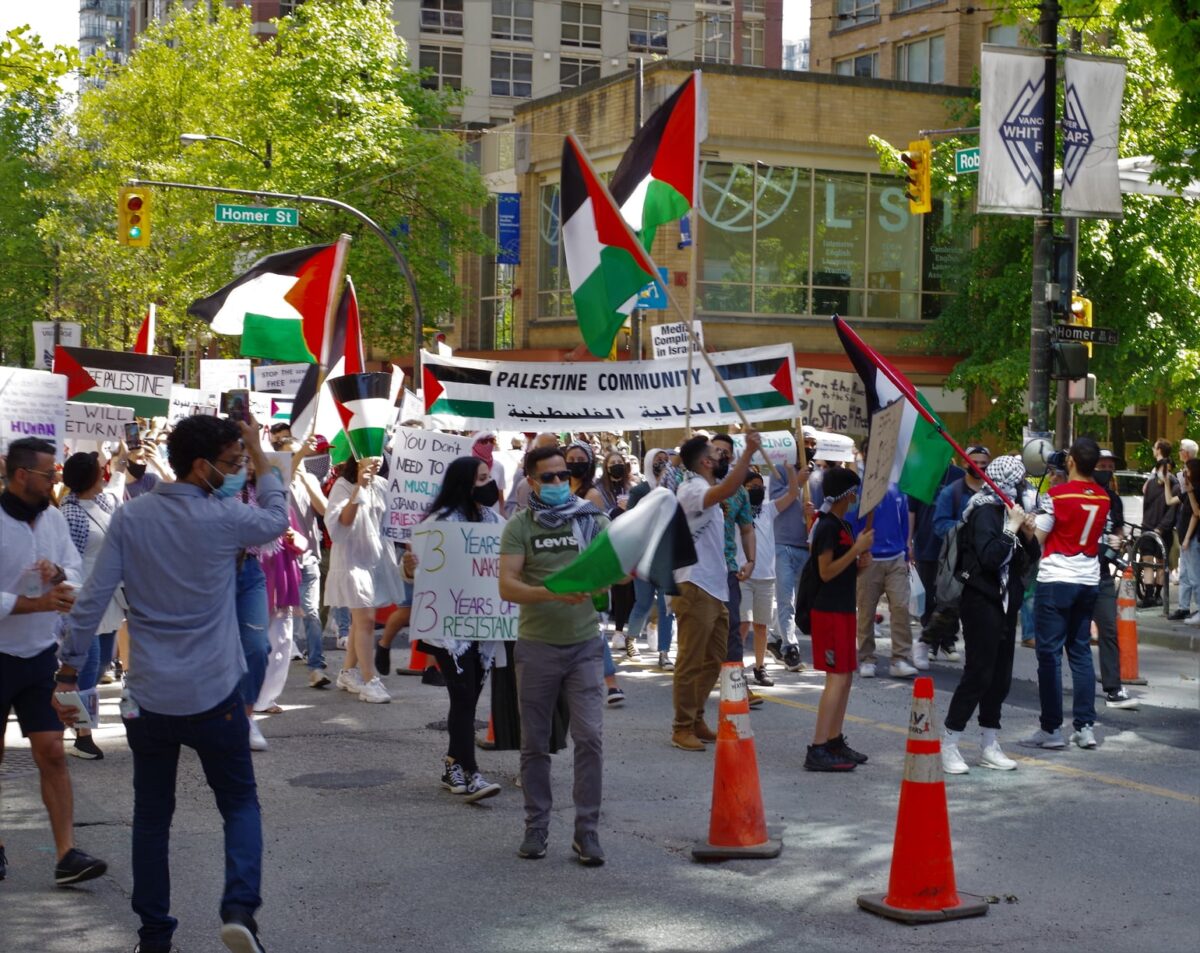
Vancouver rally (June 2021) to support #BlocktheBoat and Shut Down Zim

CBC Insists on Erasing Palestinian National Identity

The following letter was sent on September 10, 2020 to the CBC Ombudsman requesting an official review of CBC’s flawed explanation of its language guide on Palestine. The Ombudsman has already confirmed that the review will happen, noting the results will be made public on his website.

Dear Mr. Jack Nagler,
CBC Ombudsman

We have received the more detailed reply regarding CBC’s language guide on Palestine from Paul Hambleton, Director of Journalism Standards. We understand many people received a very similar response with identical points defending CBC’s insistence on not using the word “Palestine” except in very rare circumstances (i.e. part of a name). Even in that, CBC management could not adhere to its own policy when Mr. Hambleton referred to the Palestinian Liberation Organization rather than the Palestine Liberation Organization in his reply.

We are not satisfied with this response and are requesting the Ombudsman Office to launch a review of this case.
Frankly, the more CBC explains this biased policy the more convoluted their verbal gymnastics seem to become. They have now shed more light on the relevant clause that started the whole fiasco and led to The Current apologizing on air for referring to Palestine, rather than the Palestinian territories. The full clause has fastidious detailing of when not to use the word Palestine; one cannot refer even to pro-Palestine supporters, they can only be pro-Palestinian. And when referring to historic Palestine, one must use the term “British Palestine” if talking about the period of British colonial rule after WW1.

Even if one puts aside CBC’s argument on Palestine not yet being a “sovereign country”, why this obsession with removing any usage of the word Palestine in nearly all other contexts, including generic or historic ones? The “British Palestine” reference seems particularly ridiculous and archaic in post-colonial times.

Here are some documented historic facts:
a. In 1896, the founder of Zionism, Theodor Herzl wrote in his book “The Jewish State”: “In Palestine (our emphasis) … we shall be for Europe a part of the wall against Asia, we shall serve as a vanguard of civilization against barbarism.”
b. In 1897, the First Zionist Congress listed as some of the aims of the movement: “Zionism strives to create for the Jewish people a homeland in Palestine (our emphasis) secured by public law. The congress contemplates the following means to the attainment of this end:
The promotion on suitable lines of the colonization of Palestine (our emphasis) by Jewish agricultural and industrial workers…”
c. The British Balfour Declaration that adopted and legitimized Zionism stated: “His Majesty’s government view with favour the establishment in Palestine (our emphasis) of a national home for the Jewish people…”
As demonstrated, Palestine existed and was referenced as such before and during the colonial British Mandate on Palestine, the official name of which explicitly recognized Palestine. For CBC to claim that it should now be referred to only as “British Palestine” is not just dishonest, misleading and a fabrication of history, it also adopts the narrative of the Zionist movement that denies the existence of Palestine and its people.

As CBC seems to fully understand that language is an important component of defining issues, we assume that they also understand that their policy makes them complicit in trying to eradicate Palestine’s national identity. This has long been a pillar of the Zionist project, which goes to great lengths to ensure that the Palestinian struggle is not framed as a national struggle against settler-colonialism.

Mr. Hambleton stated: “We think it would be misleading to state or imply that “Palestine” is a sovereign country (which is substantially different from having “non-member observer status” at the United Nations). We also think it would be inappropriate for the CBC to unilaterally declare that Palestine suddenly exists (where are its negotiated borders?)…”

We should inform CBC that Israel has never officially demarcated its “borders” (negotiated or non-negotiated), so by this logic, it is inappropriate for CBC to use the term Israel.

Although CBC does state the term “occupied territories” is preferred to “disputed territories”, most of their language guide nonetheless refuses to frame the Palestinian and Arab struggles as national ones against a foreign occupying power. The language guides also notes, after acknowledging that the Golan Heights is “occupied territory”, that this is territory “which Israel and Syria are at odds over”. “At odds over” – really? This is not the kind of precise language that Mr. Hambleton repeatedly insists CBC wants to use when reporting on these issues. The Golan Heights is not only occupied territory, it is also illegally annexed territory, and should not be represented as a “territorial squabble”.

In response to our question on how this language guide was developed, Mr. Hambleton stated that amongst other criteria, it was based “on research and interviews conducted by CBC foreign correspondents (including interviews with Israeli and Palestinian experts inside and outside the Middle East)”. He does not specify which “Palestinian experts” were interviewed or if they were even Palestinian. We would like him to clarify who these experts are because we seriously doubt any Palestinian or knowledgeable objective expert on Palestine and its history would have agreed to such restrictions on referencing the Palestinian national struggle.

It is interesting to compare CBC’s approach to language around Kosovo. Although each situation is unique, surely there are universal principles that should guide CBC’s policies. Kosovo is not a member of the United Nations in any capacity, it is recognized by fewer countries in the world than the state of Palestine, yet CBC is happy to use the proper term Kosovo in its reporting. The only difference we can see is that the Canadian government has officially recognized Kosovo, but not Palestine. Although CBC’s mandate states it has administrative and programming independence from the Canadian government, this doesn’t seem to be the case. Their website states: “This principle of ‘arm’s length’ relationship between the CBC and government is critical to the Corporation’s independence.” This “arm’s length relationship” doesn’t seem to have held up well. Shouldn’t we just acknowledge that our national broadcaster implements the foreign policy of successive Canadian governments in its reporting? A foreign policy that resulted in Canada twice losing out on a seat at the UN Security Council, a foreign policy that desperately is in need of a review, a foreign policy that has isolated Canada internationally. CBC could better serve people in Canada by discussing these issues rather than just simply reflecting the defunct foreign policy of the day.

Finally, we strongly believe that CBC is promoting the Zionist narrative, and the official Canadian position in support of that narrative; in doing so, this makes CBC complicit in the dispossession and genocide of a whole nation and its people. It is a sad and supreme irony that the program in which CBC enforced these biased policies and denied the existence of Palestine was titled “the themes of colonialism and resource extraction”.

Regards,
Hanna Kawas, Chair
Canada Palestine Association

Updated article in Canadian Dimension: CBC Doubles Down on Erasing Palestine

Why I oppose Canada’s bid for the UN Security Council seat

(The following letter was recently sent to all UN Ambassadors from Canada Palestine Association chairperson, Hanna Kawas. The vote for non-permanent UNSC seats is set to happen June 17, 2020.)

June 12, 2020

Dear UN Ambassadors:

I am a Christian Palestinian refugee from Bethlehem who can’t return to my hometown because of my identity and because Israel refuses to implement the UNGA resolution regarding “Persons displaced as a result of the June 1967 and subsequent hostilities”. I am also the chairperson of the Canada Palestine Association. I am writing to urge you to NOT support Canada’s bid for a seat on the UN Security Council.

My late father sent a letter to the United Nations in 1948 following the dispossession of our people, appealing to the UN members at that time for justice, peace and equality. I am making one last effort in his name to speak to the conscience of this international body.

It came to my attention that Marc-André Blanchard, the Canadian UN Ambassador, sent you a letter dated June 10, 2020 stating that “Canada has long supported the creation of a Palestinian state…”. This is a blatant falsehood and reminds me of the treatment our native brothers and sisters have endured from the white settler colonialists.

On the personal level:

  • Canada, under the current Liberal government has voted for the past FIVE years against “Persons displaced as a result of the June 1967 and subsequent hostilities” resolution. Voting against this resolution is personal and affects me directly. I have with me the deeds for my grandfather’s property in Bethlehem and still I can NOT go and live in my ancestral home. The only real explanation for such a vote by Canada is that it supports Israel’s ethnic cleansing of the West Bank and subsequently supports the “Greater Israel Project”.
  • The Canadian government refused to enshrine Bethlehem, Palestine as my birthplace on my passport. I refused to accept such a denial of my identity, so I stayed stranded in Canada for nineteen years without the ability to travel. Finally, four years ago, the passport office offered to put Bethlehem, West Bank as my birthplace, which I accepted begrudgingly.

On the collective level:

  • If the Canadian government supports “the creation of a Palestinian state”, why did it vote last year AGAINST seven U.N. resolutions that affirm the “two-state” solution and call for ending the illegal occupation that has lasted for 53 years? And why does Canada vote against the other resolutions at the U.N. that uphold Palestinian human, national and refugee rights?
  • The response of the Canadian Foreign Minister François-Philippe Champagne to U.S. President Trump’s “deal of the century”, that gave the green light to Israel to annex the West Bank was: “Canada recognizes the urgent need to renew efforts toward a negotiated solution to the Israeli-Palestinian conflict, and will carefully examine the details of the U.S. initiative for the Middle East peace process”; it seems to this moment he is still “examining” it.
  • Only after the Special Rapporteur for Human Rights in the Occupied Palestinian Territory wrote “Canada missing in action on Israel’s proposed annexation of the West Bank”, and after 58 former Canadian diplomats and politicians signed a “letter calling on Prime Minister Justin Trudeau and his government to show stronger resistance to a proposed Israeli annexation”, only then did Canadian PM Trudeau pay lip-service to opposing the Israeli planed annexation.
  • On the International Criminal Court (ICC) Canada’s Foreign Ministry stated: “Canada’s longstanding position is that it does not recognize a Palestinian state … In the absence of a Palestinian state, it is Canada’s view that the Court does not have jurisdiction in this matter under international law”. Meanwhile, the Canadian UN Ambassador tells you in his letter that “Canada has long supported the creation of a Palestinian state…”
  • The Canadian government adopted the IHRA definition. Many people in Canada, of all faiths, oppose the IHRA definition because “7 of the 11 examples refer not just to Jewish people, but to the state of Israel, a deliberate rhetorical strategy to label criticism of Israel and of Zionism antisemitic.”
  • The Canada-Israel Free Trade Agreement (CIFTA) allows for the sale and false labelling of illegal settlement products in Canada. Even after the Federal Court of Canada ruled that “product of Israel” labels from wines made in West Bank settlements, in the occupied Palestinian territories, are “false, misleading and deceptive”, the Canadian government appealed this ruling. The Canadian government has refused to abide by the 2016 UN Security Council Resolution 2334, calling on member states to “distinguish, in their relevant dealings, between the territory of the State of Israel and the territories occupied in 1967.”
  • Canada gives tax deductible status to the Jewish National Fund JNF which supports settlements projects in the West Bank, including Canada Park that was built on the ruins of three Palestinian towns occupied in 1967.
  • Many Zionist organizations get tax deductible status from the Canadian government including the “Lone Soldier” organization that sends “soldiers” to fight with the Israeli military committing war crimes against the Palestinian people. It is worth noting that earlier this year the Canadian ambassador to Israel held an event “to show the appreciation and care felt by the embassy” for those mercenaries.
  • The Canadian government, under direct instruction of the Israeli lobby groups, put the major Palestinian resistance organizations struggling against Israeli occupation, on their “Terrorist List”. The previous Liberal government reaffirmed this list on Nov. 21 2018.
  • On November 2, 2018, then Foreign Minister and now Deputy PM Chrystia Freeland was quoted as follows during a visit to Israel:
    “She also mentioned Canada’s current bid for one of 10 non-permanent seats on the UN Security Council for 2021-2022, which she hoped would allow Canada to serve as an ‘asset for Israel and… strengthen our collaboration’.”

Canada has empowered Israel economically and militarily; in addition to the Free Trade agreement and the tax deduction for Zionist organizations, here are a few other examples:

  1. The exhaustive study entitled “Canadian Pension Plan (CPP) Investments in Corporations Supporting Israel’s Military, Police, Surveillance and Prison-Industrial Complex” Part 1 Part 2  
  2. Another study detailing “Canadian Military Exports to Israel: Aiding and Abetting War Crimes in Gaza (2008-2009)”
  3. Canadians can invest in Israeli Bonds tax free with their Registered Retirement Savings Plan (RRSP), Tax-Free Savings Account (TFSA) and Registered Educational Savings Plan(RESP), among other plans.

Finally, Article 1 of the Fourth Geneva Convention states: “The High Contracting Parties undertake to respect and to ensure respect for the present Convention in all circumstances.” In addition to Canada not abiding by this article, it is directly empowering Israel’s violations of international and humanitarian law.

Please don’t reward Canada for supporting and enabling Israel’s ethnic cleansing, war crimes, apartheid and genocide. I call on you in the name of my father, who died without being able to return to live in his beloved homeland, to not support Canada’s bid for a UNSC seat.

Sincerely,

Hanna Kawas,
Chairperson, Canada Palestine Association

Why we oppose Canada’s bid for the UN Security Council
Article by Hanna Kawas and Marion Kawas, June 15, 2020

This Letter was also tweeted by PLO Department of International Relations

See the reaction of Andrea Niklaus, the Canadian representative to the PA:
“[W]e wanted to flag a tweet posted last night on the PLO Public Diplomacy account, which shares/quotes an article by the Canadian-Palestine Association against Canada’s UNSC bid. … We’ve seen some negative comments on our UNSC-related posts on our mission accounts in recent days, but this is the first we’ve seen such messaging amplified from an official Palestinian account. FYI, Ramallah [Canada’s diplomatic post in the West Bank] has inquired with a contact at the PLO as whether this represents their official position on Canada’s candidacy, and they promised to look into it and get back to us.”