
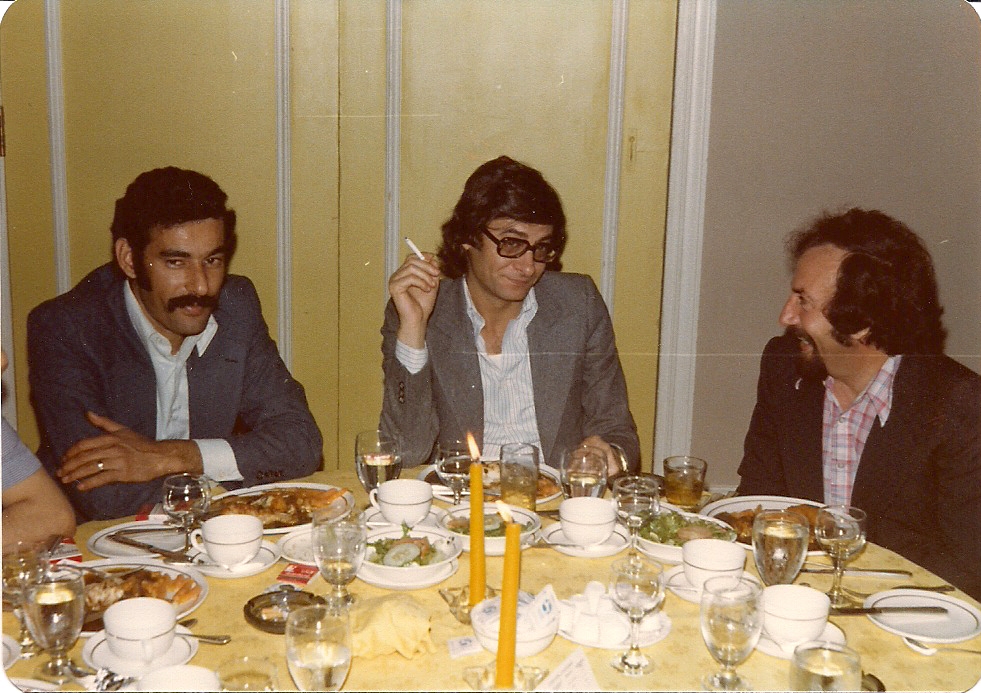
(Photo: On the right is the late Rezeq Faraj, a former president of CAF, at one of their conventions with Palestinian poet Mahmoud Darwish./Photo: à droite, feu Rezeq Faraj, ancien président de la CAF, à l’une de leurs conventions avec le poète palestinien Mahmoud Darwish.)
(le français suit)
It is important to set the record straight in response to recent distortions, defamations and attacks on CAF, the Arab community and Palestinian advocacy.
According to the Canadian press, the Bloc Québécois suggested that the new Canadian Transport Minister, Omar Alghabra, is associated with “the political Islamic movement.”
Leader Yves-François Blanchet said in a release that “questions arise” due to the minister’s former role as head of the Canadian Arab Federation.
“It’s really questions about his past and also the separation of church and state, which is a profound value for the Bloc,” said spokesman Julien Coulombe-Bonnafous. “We don’t want to raise any accusations, because I don’t think there’s that much.”
What prompted the Bloc and its leader to make such unfounded and false statements? It is very clear to us that it is politically motivated and also smacks of anti-Arab racism. This alleged association with the so-called “political Islamic movement”, especially without proof, is reprehensible and immoral.
Further, to insinuate that the Canadian Arab Federation is a hub for such a movement is ignorant, and slanderous to CAF and its objectives. For most of its 53-year history, CAF stood for secularism, universal human and national rights with the main emphasis on Palestinian and Arab liberation. CAF was led by many capable secular leaders such as the late Palestinian Quebecer Rezeq Faraj, and these slanders are a disgrace to the memory of Rezeq.
Some media reports mentioned Jason Kenney, the former citizenship and immigration Minister, who cut funding for the Canadian Arab Federation. However, it is worth noting that Mr. Kenney’s main grudge was against the secular Christian president of CAF at that time, Khaled Moammar. CPA issued a statement “Jason Kenney Is Promoting Racism” where we concluded “This intervention in the internal affairs of the Arab community being conducted by the Canadian government’s vast economic and intelligence machinery smacks of the “regime change” tactics used globally by the U.S. and other western governments…”.
For more background on Jason Kenney’s and Canadian government racism against Palestinian advocacy, the Arab community and one of its main organizations CAF, check out “Freedom of Expression and Palestine Advocacy”.
However, in condemning the blatant racism of Mr. Blanchet and the BQ, we do not need to whitewash the history of Omar Alghabra and what he has stood for during his political career.
Sadly, Alghabra has spent most of his time in Canada in service of the Canadian establishment and its multinational corporations; this is how and why he became a minister and previously the Parliament Secretary to the Prime Minister. Even when he was (briefly) the president of CAF, he hijacked the agenda of the original goals of the Federation. Canada Palestine Association (CPA), then a long-time member of CAF, issued an open letter in 2005 where it stated that “CAF policy is sinking further into a policy of collaboration and subjugation to the Canadian establishment.”
In 2016, Mr. Alghabra recommended “that all members of the House should support” the anti BDS motion in the Canadian Parliament, alongside the other Parliamentary Secretary to the Minister of Foreign Affairs Ms. Pam Goldsmith-Jones, who stated:
“Mr. Speaker, I am pleased to be sharing my time with the Hon. Member for Mississauga Centre (Omar Alghabra).
Let me reiterate that we believe that all members of the House should support the motion. The Government of Canada unequivocally opposes the boycott, divestment, and sanctions movement.”
Mr. Alghabra also considers Palestinian resistance organizations as terrorists: “Our government put Hamas on a terrorist list. We believe Hamas is a terrorist organization.” For his information, the “terrorist list” was drafted by the Zionist lobby that imposed it on the government. And if any establishment fits the terrorist description, it is the government of which he is now a minister, that at every term has supported the US-sponsored wars of TERROR on Iraq, Syria, Yemen, Libya, Haiti, Bolivia and Venezuela. Not to mention its support for Israeli war crimes and terrorism.
We condemn all forms of racism and all racist attacks in Canada; these are increasing daily and it is the marginalized people in our communities who bear the brunt of such harassment, intimidation and racial profiling and who need our urgent support and protection.
Hanna Kawas,
Chair, Canada Palestine Association
(This statement was published in The Canada Files.)
_______________________________
Le racisme anti-arabe a des racines profondes au Canada
En réponse aux récentes distorsions, diffamations et attaques contre la CAF, contre la communauté arabe et contre la défense des droits palestiniens au Canada, il est important de rétablir les faits.
D’après la presse canadienne, le Bloc québécois a laissé entendre que le nouveau ministre canadien des Transports, Omar Alghabra, était associé au « mouvement politique islamique ».
Dans un communiqué, le chef du Bloc, Yves-François Blanchet, a déclaré que « des questions se posent » en raison de l’ancien rôle du ministre à la tête de la Fédération canado-arabe.
« Ce ne sont rien d’autres que des questions sur son passé et sur la séparation de l’Église et de l’État – une valeur profonde pour le Bloc », a déclaré le porte-parole Julien Coulombe-Bonnafous. « Nous ne voulons pas porter d’accusations, car je ne pense pas qu’il y en ait autant.»
Qu’est-ce qui a poussé le Bloc et son chef à faire des déclarations aussi infondées et fausses ? Politiquement motivée, à l’évidence, ces déclarations sentent le racisme anti-arabe. Cette prétendue association avec un soi-disant « mouvement politique islamique », assénée sans preuve, est répréhensible et immorale.
Insinuer, de plus, que la Fédération canado-arabe constitue la plaque tournante d’un tel mouvement, voilà qui est ignorant et calomnieux envers la CAF et ses objectifs. Tout au long de ses 53 ans d’histoire, la CAF a défendu la laïcité, les droits humains et nationaux universels, l’accent étant mis principalement sur la libération palestinienne et arabe. La CAF a été dirigée par de nombreux dirigeants, laïcs et compétents, tels que feu Rezeq Faraj, un Québécois palestinien, et ces calomnies déshonorent sa mémoire.
Certains reportages ont évoqué Jason Kenney, l’ancien ministre de la Citoyenneté et de l’Immigration, qui avait réduit le financement de la Fédération canado-arabe. Il convient cependant de rappeler que la principale rancune de M. Kenney était à l’encontre du président de l’époque – le chrétien et laïc Khaled Moammar. L’Association Canada Palestine (CPA) a publié une déclaration intitulée « Jason Kenney fait la promotion du racisme » dans laquelle nous concluions : « Cette intervention dans les affaires internes de la communauté arabe menée par le vaste appareil économique et de renseignement du gouvernement canadien ressemble aux tactiques de « changement de régime » utilisées à l’échelle mondiale par les États-Unis et d’autres gouvernements occidentaux… ».
Pour plus d’informations sur le racisme de Jason Kenney et du gouvernement canadien contre la défense des droits palestiniens, la communauté arabe et l’une de ses principales organisations (la CAF), consultez « Liberté d’expression et défense de la Palestine ».
En condamnant le racisme flagrant de M. Blanchet et du BQ, nous n’avons pas besoin d’aller jusqu’à blanchir l’histoire d’Omar Alghabra et ce qu’il a défendu au cours de sa carrière politique.
Malheureusement, en effet, Alghabra a passé la plupart de son temps au Canada au service de l’establishment canadien et de ses sociétés multinationales; voilà comment et pourquoi il est devenu ministre et, auparavant, secrétaire parlementaire du premier ministre. Lorsqu’il a été (brièvement) président de la CAF, il a détourné l’ordre du jour de la Fédération de ses objectifs initiaux. La CPA, alors membre de longue date de la CAF, a publié une lettre ouverte en 2005 dans laquelle elle déclarait que « la politique de la CAF s’enfonce davantage dans une politique de collaboration et d’assujettissement à l’establishment canadien. »
En 2016, M. Alghabra a recommandé «que tous les députés de la Chambre appuient » la motion anti-BDS au Parlement canadien, aux côtés de l’autre secrétaire parlementaire du ministre des Affaires étrangères, Mme Pam Goldsmith-Jones, qui a déclaré:
« Monsieur le Président, je suis heureuse de partager mon temps avec l’hon. Député de Mississauga-Centre (Omar Alghabra). Permettez-moi de réitérer que nous croyons que tous les députés de la Chambre devraient appuyer la motion. Le gouvernement du Canada s’oppose sans équivoque au mouvement de boycott, de désinvestissement et de sanctions. »
M. Alghabra considère également les organisations de résistance palestiniennes comme des terroristes : « Notre gouvernement a placé le Hamas sur une liste terroriste. Nous pensons que le Hamas est une organisation terroriste. » Pour son information, la « liste des terroristes » a été rédigée par le lobby sioniste qui l’a imposée au gouvernement. Et si un établissement correspond bien à la description de terroriste, c’est le gouvernement dont il est maintenant ministre, et qui, à chaque mandat, a soutenu les guerres de TERREUR parrainées par les États-Unis contre l’Irak, la Syrie, le Yémen, la Libye, Haïti, la Bolivie et le Venezuela. Sans parler de son soutien aux crimes de guerre et au terrorisme israéliens.
Nous condamnons toutes les formes de racisme et toutes les attaques racistes au Canada ; ceux-ci augmentent chaque jour et ce sont les personnes marginalisées de nos communautés qui portent le poids de ce harcèlement, de l’intimidation et du profilage racial et qui ont besoin de notre soutien et de notre protection d’urgence.
Hanna Kawas,
Président, Canada Palestine Association