Canada’s Hypocrisy on the ICC and Palestine

Canada’s convoluted double-talk on Palestinian rights and the International Criminal Court is a true masterclass in diplomatic hypocrisy. It flows from a biased and erroneous foundation, that is both inherently anti-Palestinian and allows for sweeping Israeli impunity.

The Trudeau government claims it supports a rules-based order and the ICC, but just not when it comes to Israeli war crimes. According to the recent statement by Marc Garneau, Foreign Affairs Minister, this is because Canada does not acknowledge the ICC’s jurisdiction to launch such an investigation. And that position is based on another piece of flawed reasoning, that Canada does not recognize a Palestinian state. And will only do so if and when such a state is “achieved through direct negotiations between the parties.”

So, lets follow this argument to its conclusion. Canada doesn’t recognize a Palestinian state (except maybe when it comes to vaccines?). Therefore, they are not allowed international protection or access to forums like the ICC; and are at the mercy of the prevailing status quo, which has much of the international community either turning a blind eye to, or actively promoting, Israeli aggression and ethnic cleansing.

And if Palestinians want that to change, they must commit to another 25, or even 50, more years of endless negotiations towards a mythical two-state solution. (Never mind that they went down this road already with Oslo which promised them a state by 1998.) A solution that so far has achieved nothing for Palestinians and has in fact, entrenched even more loss of land and loss of rights. Negotiations that basically give Israel, as the occupying and militarily superior force, veto power over what will be allowed. Ghassan Kanafani, the late Palestinian writer and thinker, aptly summed it up as a “conversation between the sword and the neck”.

Still, Canada repeatedly claims it is “firmly committed to a two-state solution”, a claim that rings hollow. Many Security Council resolutions have been passed, calling on Israel to end its illegal occupation of Palestinian and Arab territories including UNSC resolution 242 of Nov. 22, 1967 and resolution 338 of Oct. 22, 1973 (that reaffirmed resolution 242). If the Canadian government were genuinely concerned about this brutal occupation that has inflicted untold suffering and atrocities against the Palestinian people, they could have taken any number of concrete actions, such as sanctions or honouring Article One of the Fourth Geneva Convention. But in a clear sign that they are willing to allow Israeli violations of International Humanitarian Law and Israel’s flouting of UN resolutions, successive Canadian governments have done nothing but sustain and provide cover for Israeli war crimes.

But not to fear, every once in a while, Canada will make some shallow gesture or nice photo-op, to show that they really do care about Palestinians and their rights. Some funding for UNRWA, but only if we can control the books in their schools and every action from their senior managers. Or a Canadian diplomat shows up in a photo at a West Bank location with EU reps to demonstrate their opposition to yet another Israeli demolition of a school or a village. But don’t expect any further meaningful action once that school is actually demolished, because that type of serious challenge to the Israeli government’s trampling of Palestinian rights is not on the agenda of the Canadian government.

Canada Palestine Association, Feb. 9, 2021

Anti-Arab racism has deep roots in Canada/Le racisme anti-arabe a des racines profondes au Canada

(Photo: On the right is the late Rezeq Faraj, a former president of CAF, at one of their conventions with Palestinian poet Mahmoud Darwish./Photo: à droite, feu Rezeq Faraj, ancien président de la CAF, à l’une de leurs conventions avec le poète palestinien Mahmoud Darwish.)

(le français suit)

It is important to set the record straight in response to recent distortions, defamations and attacks on CAF, the Arab community and Palestinian advocacy.

According to the Canadian press, the Bloc Québécois suggested that the new Canadian Transport Minister, Omar Alghabra, is associated with “the political Islamic movement.”
Leader Yves-François Blanchet said in a release that “questions arise” due to the minister’s former role as head of the Canadian Arab Federation.
“It’s really questions about his past and also the separation of church and state, which is a profound value for the Bloc,” said spokesman Julien Coulombe-Bonnafous. “We don’t want to raise any accusations, because I don’t think there’s that much.”

What prompted the Bloc and its leader to make such unfounded and false statements? It is very clear to us that it is politically motivated and also smacks of anti-Arab racism. This alleged association with the so-called “political Islamic movement”, especially without proof, is reprehensible and immoral.

Further, to insinuate that the Canadian Arab Federation is a hub for such a movement is ignorant, and slanderous to CAF and its objectives. For most of its 53-year history, CAF stood for secularism, universal human and national rights with the main emphasis on Palestinian and Arab liberation. CAF was led by many capable secular leaders such as the late Palestinian Quebecer Rezeq Faraj, and these slanders are a disgrace to the memory of Rezeq.

Some media reports mentioned Jason Kenney, the former citizenship and immigration Minister, who cut funding for the Canadian Arab Federation. However, it is worth noting that Mr. Kenney’s main grudge was against the secular Christian president of CAF at that time, Khaled Moammar. CPA issued a statement “Jason Kenney Is Promoting Racism” where we concluded “This intervention in the internal affairs of the Arab community being conducted by the Canadian government’s vast economic and intelligence machinery smacks of the “regime change” tactics used globally by the U.S. and other western governments…”.
For more background on Jason Kenney’s and Canadian government racism against Palestinian advocacy, the Arab community and one of its main organizations CAF, check out “Freedom of Expression and Palestine Advocacy”.

However, in condemning the blatant racism of Mr. Blanchet and the BQ, we do not need to whitewash the history of Omar Alghabra and what he has stood for during his political career.

Sadly, Alghabra has spent most of his time in Canada in service of the Canadian establishment and its multinational corporations; this is how and why he became a minister and previously the Parliament Secretary to the Prime Minister. Even when he was (briefly) the president of CAF, he hijacked the agenda of the original goals of the Federation. Canada Palestine Association (CPA), then a long-time member of CAF, issued an open letter in 2005 where it stated that “CAF policy is sinking further into a policy of collaboration and subjugation to the Canadian establishment.”

In 2016, Mr. Alghabra recommended “that all members of the House should support” the anti BDS motion in the Canadian Parliament, alongside the other Parliamentary Secretary to the Minister of Foreign Affairs Ms. Pam Goldsmith-Jones, who stated:
“Mr. Speaker, I am pleased to be sharing my time with the Hon. Member for Mississauga Centre (Omar Alghabra).
Let me reiterate that we believe that all members of the House should support the motion. The Government of Canada unequivocally opposes the boycott, divestment, and sanctions movement.”

Mr. Alghabra also considers Palestinian resistance organizations as terrorists: “Our government put Hamas on a terrorist list. We believe Hamas is a terrorist organization.” For his information, the “terrorist list” was drafted by the Zionist lobby that imposed it on the government. And if any establishment fits the terrorist description, it is the government of which he is now a minister, that at every term has supported the US-sponsored wars of TERROR on Iraq, Syria, Yemen, Libya, Haiti, Bolivia and Venezuela. Not to mention its support for Israeli war crimes and terrorism.

We condemn all forms of racism and all racist attacks in Canada; these are increasing daily and it is the marginalized people in our communities who bear the brunt of such harassment, intimidation and racial profiling and who need our urgent support and protection.

Hanna Kawas,
Chair, Canada Palestine Association

(This statement was published in The Canada Files.)
_______________________________

Le racisme anti-arabe a des racines profondes au Canada

En réponse aux récentes distorsions, diffamations et attaques contre la CAF, contre la communauté arabe et contre la défense des droits palestiniens au Canada, il est important de rétablir les faits.

D’après la presse canadienne, le Bloc québécois a laissé entendre que le nouveau ministre canadien des Transports, Omar Alghabra, était associé au « mouvement politique islamique ».

Dans un communiqué, le chef du Bloc, Yves-François Blanchet, a déclaré que « des questions se posent » en raison de l’ancien rôle du ministre à la tête de la Fédération canado-arabe.

« Ce ne sont rien d’autres que des questions sur son passé et sur la séparation de l’Église et de l’État – une valeur profonde pour le Bloc », a déclaré le porte-parole Julien Coulombe-Bonnafous. « Nous ne voulons pas porter d’accusations, car je ne pense pas qu’il y en ait autant.»

Qu’est-ce qui a poussé le Bloc et son chef à faire des déclarations aussi infondées et fausses ? Politiquement motivée, à l’évidence, ces déclarations sentent le racisme anti-arabe. Cette prétendue association avec un soi-disant « mouvement politique islamique », assénée sans preuve, est répréhensible et immorale.

Insinuer, de plus, que la Fédération canado-arabe constitue la plaque tournante d’un tel mouvement, voilà qui est ignorant et calomnieux envers la CAF et ses objectifs. Tout au long de ses 53 ans d’histoire, la CAF a défendu la laïcité, les droits humains et nationaux universels, l’accent étant mis principalement sur la libération palestinienne et arabe. La CAF a été dirigée par de nombreux dirigeants, laïcs et compétents, tels que feu Rezeq Faraj, un Québécois palestinien, et ces calomnies déshonorent sa mémoire.

Certains reportages ont évoqué Jason Kenney, l’ancien ministre de la Citoyenneté et de l’Immigration, qui avait réduit le financement de la Fédération canado-arabe. Il convient cependant de rappeler que la principale rancune de M. Kenney était à l’encontre du président de l’époque – le chrétien et laïc Khaled Moammar. L’Association Canada Palestine (CPA) a publié une déclaration intitulée « Jason Kenney fait la promotion du racisme » dans laquelle nous concluions : « Cette intervention dans les affaires internes de la communauté arabe menée par le vaste appareil économique et de renseignement du gouvernement canadien ressemble aux tactiques de « changement de régime » utilisées à l’échelle mondiale par les États-Unis et d’autres gouvernements occidentaux… ».

Pour plus d’informations sur le racisme de Jason Kenney et du gouvernement canadien contre la défense des droits palestiniens, la communauté arabe et l’une de ses principales organisations (la CAF), consultez « Liberté d’expression et défense de la Palestine ».

En condamnant le racisme flagrant de M. Blanchet et du BQ, nous n’avons pas besoin d’aller jusqu’à blanchir l’histoire d’Omar Alghabra et ce qu’il a défendu au cours de sa carrière politique.

Malheureusement, en effet, Alghabra a passé la plupart de son temps au Canada au service de l’establishment canadien et de ses sociétés multinationales; voilà comment et pourquoi il est devenu ministre et, auparavant, secrétaire parlementaire du premier ministre. Lorsqu’il a été (brièvement) président de la CAF, il a détourné l’ordre du jour de la Fédération de ses objectifs initiaux. La CPA, alors membre de longue date de la CAF, a publié une lettre ouverte en 2005 dans laquelle elle déclarait que « la politique de la CAF s’enfonce davantage dans une politique de collaboration et d’assujettissement à l’establishment canadien.  »

En 2016, M. Alghabra a recommandé «que tous les députés de la Chambre appuient » la motion anti-BDS au Parlement canadien, aux côtés de l’autre secrétaire parlementaire du ministre des Affaires étrangères, Mme Pam Goldsmith-Jones, qui a déclaré:

« Monsieur le Président, je suis heureuse de partager mon temps avec l’hon. Député de Mississauga-Centre (Omar Alghabra). Permettez-moi de réitérer que nous croyons que tous les députés de la Chambre devraient appuyer la motion. Le gouvernement du Canada s’oppose sans équivoque au mouvement de boycott, de désinvestissement et de sanctions. »

M. Alghabra considère également les organisations de résistance palestiniennes comme des terroristes : « Notre gouvernement a placé le Hamas sur une liste terroriste. Nous pensons que le Hamas est une organisation terroriste. » Pour son information, la « liste des terroristes » a été rédigée par le lobby sioniste qui l’a imposée au gouvernement. Et si un établissement correspond bien à la description de terroriste, c’est le gouvernement dont il est maintenant ministre, et qui, à chaque mandat, a soutenu les guerres de TERREUR parrainées par les États-Unis contre l’Irak, la Syrie, le Yémen, la Libye, Haïti, la Bolivie et le Venezuela. Sans parler de son soutien aux crimes de guerre et au terrorisme israéliens.

Nous condamnons toutes les formes de racisme et toutes les attaques racistes au Canada ; ceux-ci augmentent chaque jour et ce sont les personnes marginalisées de nos communautés qui portent le poids de ce harcèlement, de l’intimidation et du profilage racial et qui ont besoin de notre soutien et de notre protection d’urgence.

Hanna Kawas,
Président, Canada Palestine Association

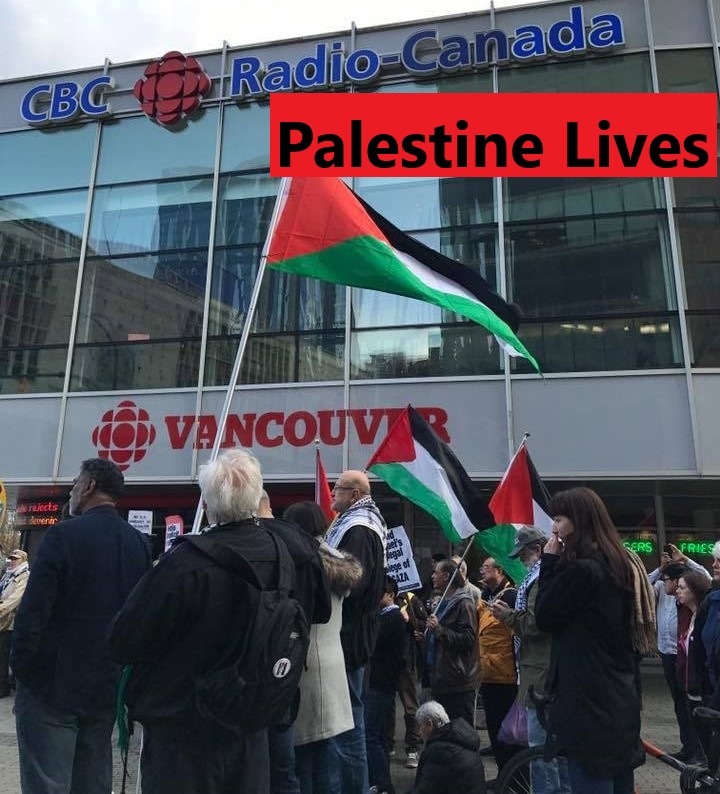
CBC still mulling over its anti-Palestinian bias

Last summer’s fiasco at Canada’s national broadcaster CBC over its censure of the word Palestine has brought new focus to the debate over why there is such pro-Israel bias in most media in North America.

Some brief background: The CBC show “The Current” had an interview with Joe Sacco where the host used the word Palestine. This was deleted in the later online version and apologized for the next day. In the subsequent uproar from listeners about this action, it was learnt that CBC’s language guide actually embeds this kind of anti-Palestinian discourse. The relevant clause in their language guide was more extreme than some “hasbara” handbooks, basically “NO” to all things Palestine.

Four months later, the case is still under review at the CBC’s Ombudsman office; but the results of his investigation are by no means guaranteed to overturn their archaic policies, either in respecting universal human rights or even common journalistic practice. We hope this will not be a case of “the mountain laboured and brought forth a mouse”, as happened with a previous complaint involving biased coverage at CBC.

Which begs the question – why is anti-Palestinianism so entrenched at Western media outlets like CBC? Is it simply because of the influence of the Zionist lobby or are there other factors at play? Is it because Canada also shares a settler colonialist past? Or is it because of Canada’s subservience to U.S. foreign policy?

An article written in July 2020 titled “Uncovering Canadian Media’s Devastating pro-Israel Bias” by journalist Davide Mastracci offered a glimpse into the reality of how media has become so dangerously biased.

The “blunt force trauma” approach described so accurately in Mastracci’s article that was prevalent in the Israel Asper/CanWest era in Canada lives on in a more covert legacy like CBC’s language guide. Following are excerpts from that convoluted language guide on Palestine vs. Palestinian territories, as detailed in an official response by Paul Hambleton, Director of Journalistic Standards.

“Palestine vs. Palestinian territories — There is no modern country of Palestine, although there’s a movement to establish one as part of a two-state peace agreement with Israel. So do not refer to Palestine or show a map with Palestine as a country. Use the term “pro-Palestinian” instead of “pro-Palestine” when referring in generic ways to Palestinian supporters. Areas under the control of the Palestinian Authority are considered Palestinian territories: Fatah-run West Bank and Hamas-run Gaza Strip…But the UN does not grant nationhood, and it remains premature to call Palestinian territories the country of Palestine. When making references to historical Palestine, use clear language (e.g., “British Palestine” is the accepted term for the British Mandate of Palestine, which administered the region between 1920 and the birth of Israel in 1948).”

Multiple inaccuracies in this policy were already highlighted in Canada Palestine Association’s request to the Ombudsman Office for a review, from the colonialist nature of so-called “British Palestine” to the extreme and petty refusal to even allow pro-Palestine as a generic term. But another point that needs addressing: what is this “Fateh-run West Bank and Hamas-run Gaza”? Does CBC talk about Likud-run Israel? Or Saud Royal Family-run Saudi Arabia? And this particular phrase also stands out: “But the UN does not grant nationhood”. But hold on a minute, didn’t the UN already do precisely that in 1947 with Israel, by passing the Partition Plan and Resolution 181?? This level of arrogance and condescension, coupled with a conscious refusal to portray the Palestinians as a national unit and entity, runs deep.

This approach is also prevalent in the Canadian government’s stated policy, which CBC refers to as backup for its flawed language guide. At first blush, Canada’s official position might appear somewhat fair-minded, although of course always favouring Israel’s security as the first criteria to consider. But a closer look reveals that, with the exception of using proper names like Palestine Liberation Organization and Palestine National Council, there is also no use of the word Palestine throughout the entire document (exactly like CBC). Any logical mention of the state of Palestine or just Palestine is replaced by the more ambiguous “Palestinian state”.  For example, the Canadian government is supposedly committed at some undetermined point in the future to a “Palestinian state living side by side…with Israel”.

Is this accidental or is there a coordinated effort here as well to undermine any references to the national identity of Palestine? Is this done intentionally to bolster the Israeli narrative, a narrative guaranteed to never result in a genuinely sovereign and independent state of Palestine?

Words are important weapons in the hands of Israel and its international supporters, and Zionist ideologues have worked for decades to sanitize language to better favour their goals and objectives. This is why they refuse to speak of Palestinians in Israel, instead they must be called Arab Israelis (another policy favoured by CBC although they seem confused if it should be Arab Israelis or Israeli Arabs). That’s why they talk of agreements between Israel and the Palestinians, not Israel and Palestine. And that’s why the Canadian government’s voting record at the UN, despite its more recent claims to recognize Palestinian self-determination, ends up overwhelmingly supporting the “Greater Israel” settler colonialist project.

CBC’s mishandling of this issue has had the unintended result of shining a spotlight on the decades-old erasure of Palestinian national identity in both the Canadian media and government. Be it interference in university hiring, or appointing notorious pro-Israel advocates to police free speech, or CBC’s outrageously biased language guide, it seems the attempt to eviscerate all things Palestine is moving forward with an increasing intensity and ruthlessness.

Denying the existence and culture of indigenous peoples, and denying the humanity of the colonized, are all shared traits in the supremacist mentality of settler colonialists. But such fabrications, negation of Palestinian identity and racist pronouncements will not halt the Palestinian march towards equality, liberation and return.

by Marion Kawas 

Another version of this article was carried in Mondoweiss.

Its wrong to legitimize supporters of Israeli militarism!

It pains Palestinian activists that even now, in 2020, we are forced to call out our allies on dealing with defenders of Israeli apartheid. Several organizations are having a webinar on October 15th about the important subject of why the Canadian government is insisting on spending billions of dollars on buying new fighter jets. The initial event announcement showed several speakers including Paul Manly, MP and Leah Gazan, MP along with other prominent figures. Canada Palestine Association was shocked to discover on October 9 that the name of Randall Garrison, NDP MP on Vancouver Island, was added to the line-up.

Why is Randall Garrison being included on this panel? He has a well-documented history of anti-Palestinian behaviour and his statements on the fighter jets have been uninspiring at best. Simply because of his position as NDP defense critic? Why bestow a “progressive” cover to a politician that is openly supporting Israel’s aggressions against the Palestinian people?

For those not familiar with Garrison’s history on the Palestinian issue, a simple internet search will bring up a mountain of information. He is vice-chair of the Canada Israel Interparliamentary Group, he reposts articles and statements that denounce BDS and call it anti-Semitic, he retweets posts from the Israel Defense Forces, and he is probably considered the most pro-Israel of all of the sitting NDP MPs.

But lets look at Randall Garrison’s public statements on the issue of Canada purchasing new warplanes. He made an official statement over a year ago saying that whatever jet was chosen should be a Made-in-Canada option and have a priority on Arctic capabilities. There was no criticism of the idea of getting new jets, just that they should be made here and contribute to the Canadian economy. The same sentiment was repeated just last month in an interview in Canadian Defence Review, where he also rejected the need for defense spending cuts despite the pandemic.

Some reports have suggested that an alternative to the new warplanes could be armed drones, and one of the main competitors for Canada’s new drones is ‘Team Artemis’, a partnership between MAS, a subsidiary of L3Harris Technologies, and Israel Aerospace Industries (IAI). The actual drone would be a “Canadianized” version of the IAI Heron TP drone. And according to Canadian Defence Review, “the Artemis’ Heron TP platform is mission-proven. The Israeli Air Force (IAF) has flown the Heron TP UAV for tens of thousands of hours since 2010 and it has been operated extensively under combat conditions.” To decode, that means it has been tested on Palestinians and Arabs, especially in Gaza, Lebanon and Syria.

So perhaps that’s something Randall Garrison might favour – an Israeli drone, the production of which will be done in Canada and also meets criteria for operating in the Arctic. That would certainly check all the boxes for our pro-Israel NDP Defense Critic.

A discussion on why militarism is wrong cannot be conducted with a speaker that is himself an advocate of Canadian militarism, and cheering for Israeli militarism that regularly kills and wounds Palestinian civilians. A speaker that refused to sign a simple pledge against Israeli annexation. A speaker that helps chair a parliamentary group that “works alongside the Centre for Israel and Jewish Affairs (CIJA) and the Canadian Jewish Political Affairs Committee (CJPAC) to host lobbying events on Parliament Hill.”

Canada Palestine Association tried unsuccessfully to convince the organizers of the event to not include Randall Garrison on their platform. We now call publicly on solidarity groups who have endorsed this event to withdraw their names as endorsers and reject any association with this legitimization of a supporter of Israeli apartheid.

It should not be incumbent upon the victims of Israeli colonial violence to always have to point out these glaring contradictions. Contradictions that should never occur in the first place by genuine progressives and internationalists. This is not a burden we should be expected to carry any longer.

Another version of this article appeared on Mondoweiss under the title: The glass ceiling for Palestinian rights

Sabra and Shatila massacre: a scar that won’t heal

There are certain profound events in a nation’s history that leave an indelible mark on all its people. The massacre in two Palestinian refugee camps in Beirut, Sabra and Shatila, on September 16, 1982 stands as one of those events.

Taking place during the course of the Lebanese civil war, Israeli forces shot flares into the night sky, lighting the way for far-right Lebanese militias to carryout the systematic killing of up to 3500 Palestinian and Lebanese men, women and children. The massacre lasted 48 hours.

Sabra and Shatila signalled the end of an era for the Palestinian resistance movement. An era that grew from the refugee camps in Lebanon and honored Palestinian refugees and their right of return; an era that did not question the value of armed struggle in national liberation; an era that nurtured some of the best of Palestinian cultural and political life; an era that restored Palestinian dignity after the harrowing years that followed the Nakba.

In 1982, the U.S. administration betrayed the written guarantees they had given to the PLO to protect Palestinian civilians in the refugee camps. An article by Palestinian academic Rashid Khalidi in 2017 titled “The United States was responsible for the 1982 massacre of Palestinians in Beirut” studied what guarantees were given by U.S. officials and what they knew at the time. Khalidi also noted in his conclusion that the “ill-considered and morally flawed decisions about the 1982 war that were made by American policy-makers” continue to this day, with the same dangerous repercussions.

Nonetheless, a decade later, the Palestinian leadership agreed to the Oslo Accords, which we now know did immense damage to the Palestinian struggle. Where would the Palestinians stand now if the Oslo Accords had never been ratified, if the First Intifada had continued, if the PLO still inspired unity and stood for all the concepts encompassed in its name?

In 2007, on the 25th anniversary of the Sabra and Shatila massacres, I wrote a commentary that was presented on the Voice of Palestine radio show in Vancouver. Sadly, its words still ring true; we are still waiting for justice, not only for the victims and survivors of Sabra and Shatila but for all Palestinians.

“It was September 1982. The summer had been brutal, the Israeli invasion of Lebanon being the issue we lived with, woke up to, and went to bed with. There was no internet, and our days were consumed with obtaining even the smallest slivers of news about the Palestinian and Lebanese casualties of the war, that numbered in the tens of thousands. We organized rallies, raised money for humanitarian aid, but none of it could erase or even reduce the emotional turmoil we constantly faced.

And then, as we all debated how and why the PLO forces left Beirut with supposed U.S. guarantees for the safety of civilians, we began to receive the flickering images on our TV screens of piled up and disfigured bodies from Sabra and Shatila. At first, the full horror of it was not immediately realized, and again, it took some time before all the details emerged. At least 3000 civilians (bodies were dumped in mass graves so figures are at best conservative) butchered and mutilated by Lebanese fascist forces with the full support of the occupying Israeli army in manners almost too gruesome to think about. And all of this with American guarantees for civilian safety.

We were like people in shock, numbly going ahead with plans for large protests but knowing at some deeper level, that the tragedy here would take a long time to process.

Many events happened in the aftermath but none brought the smallest amount of justice to the Sabra and Shatila victims. Ariel Sharon was found complicit even by Israeli institutions, but then returned as prime minister some years later. The victims tried to receive some modicum of accountability with their lawsuit in Belgian courts, which was then squashed by pressure from U.S. and other governments. Once again, the massacre of Palestinians was an inconvenient reality, and the memory of it even more inconvenient.”

Perhaps the new normalization/weapons agreements that have just been signed at the White House, one day before the Sabra and Shatila anniversary, will be looked back on by future analysts as marking the end of another era. The era of U.S. hegemony, destruction, and disregard for the lives and livelihood of the Palestinian and Arab peoples. And only then will the scars of the Sabra and Shatila massacre truly begin to heal.

by Marion Kawas
Pubished Sept. 17, 2020 in Mondoweiss